
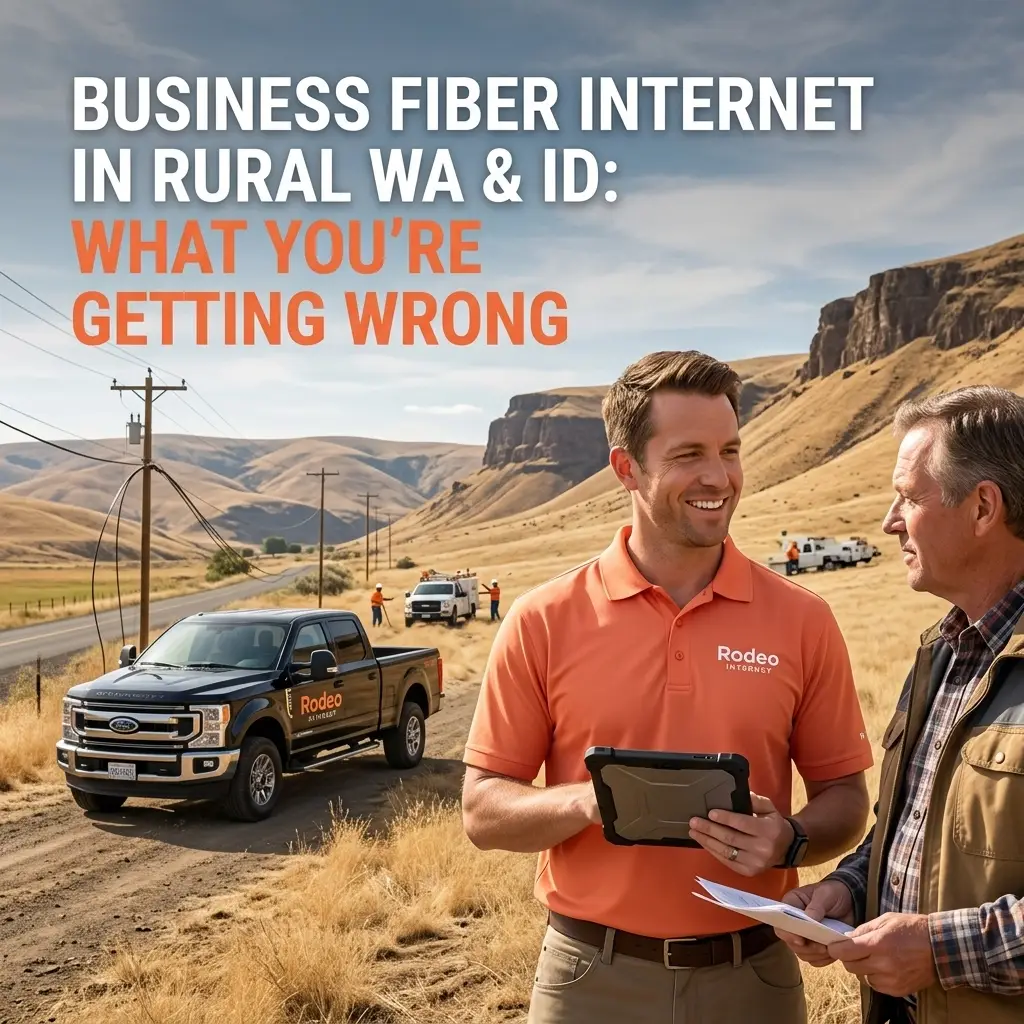
Is Fiber Internet the only reliable option for rural businesses in Washington and Idaho?
The short answer: No. While fiber is fast, a single fiber line in a rural area is a single point of failure. The most reliable business internet setup in regions like Lewiston, Clarkston, and Ritzville is a dual-path hybrid architecture. This combines high-speed fiber for daily operations with a redundant Fixed Point Wireless connection. This setup ensures that if a backhoe cuts your fiber line (a common occurrence in growing rural areas), your business stays online via wireless failover without skipping a beat.
In places like Lewiston, Clarkston, and Ritzville, the conversation around internet has shifted dramatically in the last few years. Not long ago, the question was whether you could get reliable internet at all. Today, the assumption is that fiber has arrived and solved everything.
At Rodeo Networks, we love fiber. We build it, we maintain it, and we provide it. But we also know that the "fiber is a magic wand" assumption is where most businesses make their first, and most expensive, mistake.
Fiber has absolutely improved the landscape. Speeds are higher, latency is lower, and availability is better than it has ever been in rural Washington and Idaho. But if you equate fiber with absolute reliability, if you believe that simply having a fiber line means your business is 100% protected, you are operating under a false sense of security.
The reality is more nuanced, and understanding it matters if your business depends on being online to process credit cards, run cloud-based POS systems, or host VoIP calls.
How Did We Actually Get Here? (A History of Rural Connectivity)
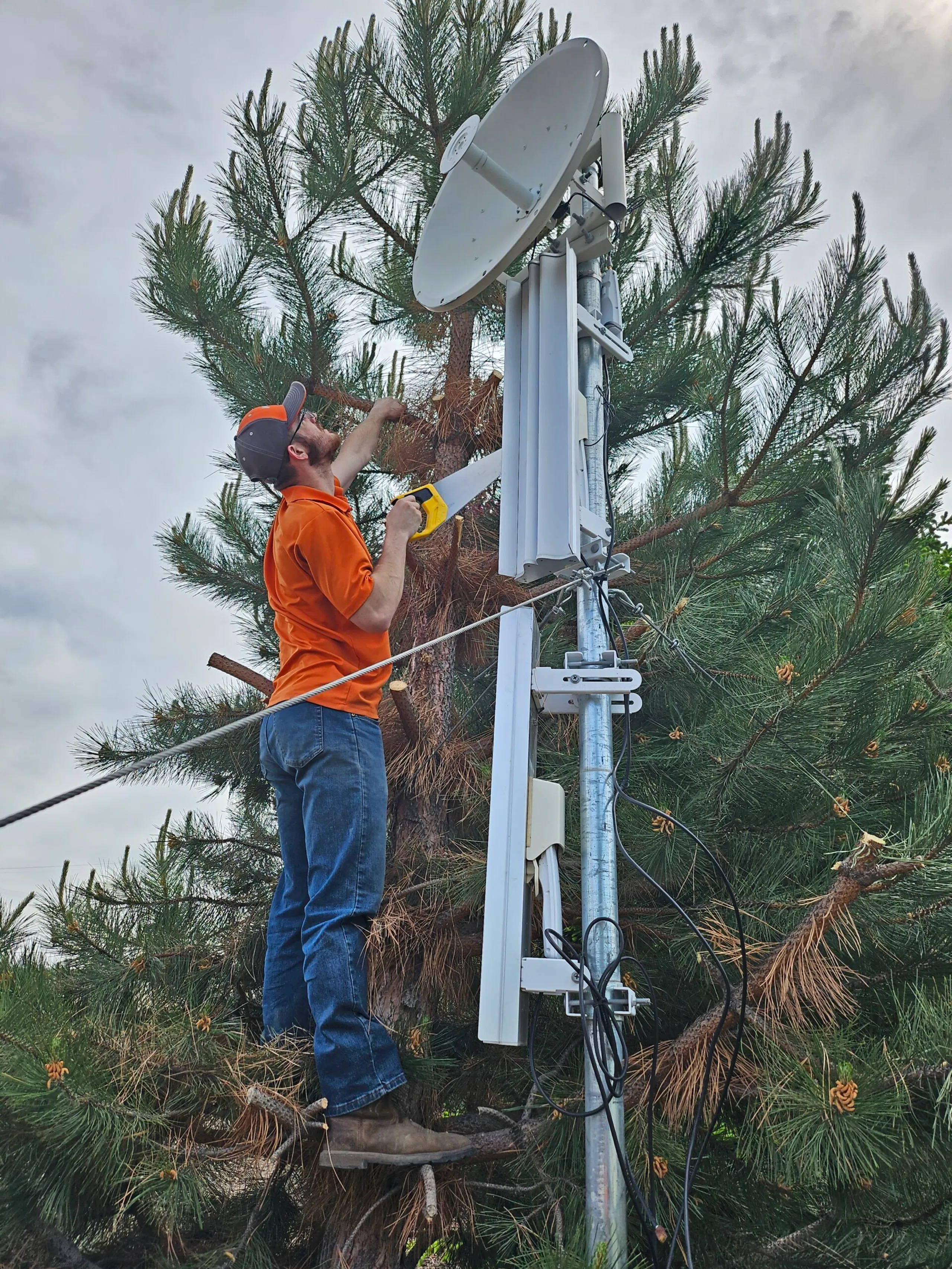
Rural connectivity did not begin with fiber. Long before trenching crews showed up in the Asotin or Anatone areas, providers in this region were solving the problem with fixed wireless. That wasn’t a temporary workaround, it was the only economically viable way to connect large geographic areas with low population density.
Companies like Rodeo Internet built networks that could deliver meaningful bandwidth across miles of rugged terrain where fiber simply wasn’t going to be built any time soon. Those networks are still in place today, and more importantly, they are still relevant.
Fiber didn’t replace wireless. It layered on top of it.
What you have now in most rural markets is not a "pure" fiber network or a wireless network. It’s a hybrid system, whether customers realize it or not. Some segments are fiber-fed. Some use wireless backhaul. Some are a mix of both. The idea that everything is now “pure fiber” is largely a marketing narrative, not an engineering reality.
Why Does the "Fiber Assumption" Break Down in Rural Areas?
Fiber has earned its reputation for a reason. It is incredibly fast, consistent, and capable of carrying enormous amounts of data. In urban environments like Seattle or Boise, with dense infrastructure and multiple redundant underground paths, it can be extremely resilient.
But rural deployments in Northern Idaho and Eastern Washington are different.
When fiber is cut, and it gets cut more often than people expect, it doesn’t matter how fast it was a moment ago. A single construction mistake, a backhoe in the wrong place during a new build in Clarkston, or a failure upstream can take out service for an entire zip code. In smaller markets, there are often fewer redundant physical routes and fewer local crews available to respond quickly.
So while fiber reduces many problems, it does not eliminate risk. It simply changes the nature of that risk.
The Metric That Misleads Business Owners: "The Five Nines"
If you measure network performance over time, a well-run system might achieve something like 99.999% uptime (often called "five-nines"). On paper, that is an impressive number. It means only minutes of downtime across years of operation.
But for a business in Lapwai or Ritzville, that number can be misleading.
Five-nines uptime still allows for outages. And those outages don’t distribute themselves conveniently. They don’t occur at 3 a.m. when your business is closed. They happen at the worst possible time, during the lunch rush, during a major transaction, or when your team is in the middle of a critical deadline.
From a purely statistical perspective, your network can be excellent. From a business perspective, a single two-hour outage on a Friday afternoon can be a disaster. That gap, between statistical reliability and real-world operational impact, is where most businesses get caught off guard.

What Are You Actually Buying: A Connection or Reliability?
When a business signs up for internet service, the assumption is that they are buying reliability. In reality, with most big national carriers, you are just buying a connection.
Those are not the same thing.
A connection is a single path from Point A to Point B. If that path fails, service stops. It doesn’t matter whether the path is fiber, wireless, or copper. If it is the only path, it is a single point of failure. Reliability, on the other hand, is not about the quality of one connection; it is about what happens when that connection inevitably fails.
Why the Conversation Needs to Change
In a competitive market with dozens of providers, most of the messaging revolves around speed and price. Faster speeds, lower costs, better promotional rates. That messaging works well for residential customers, but it does not address the real needs of a business.
A business in downtown Lewiston does not benefit from having a 10-Gigabit connection if that connection goes down and there is no backup. What matters is continuity, the ability to remain operational regardless of what happens to any single piece of infrastructure.
That is not a bandwidth problem. It is an architecture problem.
The Role of Wireless in a Fiber World
One of the more interesting misconceptions right now is that wireless becomes irrelevant once fiber arrives. From a technical perspective, the opposite is true. Wireless and fiber fail in different ways. Fiber is susceptible to physical cuts (backhoes, storms, landslides). Wireless is susceptible to different environmental factors but is immune to a shovel in the ground.
When designed correctly, a wireless connection does not compete with fiber. It complements it. It becomes a second path, an entirely separate route that can carry traffic when the primary path is unavailable.

What Reliable Connectivity Looks Like (Service Availability)
At Rodeo Networks, we take a different approach to rural connectivity. We understand that a business in Asotin has different needs than a home in Clarkston. Below is a breakdown of how we deploy these technologies across our service areas.
Rodeo Networks Service Availability Matrix
| Location | Residential Fiber | Business Fiber | Fixed Point Wireless (Up to 1Gbps) |
|---|---|---|---|
| Lewiston, ID | No (Wireless only) | Yes | Yes |
| Clarkston, WA | Yes | Yes | Yes |
| Ritzville, WA | Yes | Yes | Yes |
| Asotin, WA | No (Wireless only) | Yes | Yes |
| Anatone, WA | No (Wireless only) | Yes | Yes |
| Lapwai, ID | No (Wireless only) | Yes | Yes |
Note: For residential customers in Lewiston, Asotin, Anatone, and Lapwai, our Fixed Point Wireless (FPW) offers speeds up to 1Gbps, making it a powerful alternative to satellite or traditional cable.
Why Local Providers Have the Edge in WA & ID
In markets like the Lewiston-Clarkston Valley, local providers like Rodeo Networks operate differently than national giants. We build and maintain infrastructure across multiple technologies, and we are physically present in the communities we serve.
A national provider may deliver a fiber connection to your building, but they are unlikely to manage what happens inside your network. They typically do not design redundancy for you, and they certainly don’t take responsibility for keeping your business operational beyond the wall jack.
A local provider with both wireless and fiber capabilities can design the entire solution. We can integrate multiple paths, monitor your performance, and respond in minutes: not days: when something goes wrong. We even offer custom network builds and security camera setup services to ensure your entire infrastructure is solid.

The Economics of Getting It Wrong
There is a tendency to evaluate internet service purely on monthly cost. A business might save $50 a month by choosing a lower-cost provider or a simpler setup. But if that choice results in a single day of downtime, the financial impact: lost transactions, idle staff, and frustrated customers: can exceed those "savings" for the entire year.
In rural Idaho and Washington, where the terrain is tough and the weather is unpredictable, the cost of a single point of failure is simply too high for a modern business.
Final Thought: Speed is Easy, Reliability is Hard
Rural connectivity has improved dramatically. We are proud to offer some of the fastest internet in Lewiston and surrounding areas. But the underlying reality hasn't changed: infrastructure can break.
The businesses that understand this: and design around it: are the ones that avoid disruption. Whether you need Business Fiber in Lewiston or high-speed wireless in Anatone, the goal should be the same: continuity.
Because in the end, speed is easy to advertise. Reliability is harder to engineer. And continuity: the ability to stay operational no matter what happens: is what actually defines a successful modern business network.
Ready to stop worrying about your connection? Contact our social media team or stop by our downtown office to talk about a custom redundant build for your business. We might even show you a picture of Samson or Rodeo Ruby while you're here!
Comments are closed