From our hometown to wherever you call home.
Outdoor Rodeo Stampede 5G antennas

Better placement.
Better possibilities.

Bring your Rodeo Stampede 5G connection out from behind thick walls, metal siding or a poorly positioned indoor router.

Check your router first.Not all routers or modems accept an external Rodeo Stampede 5G antenna. Wi-Fi antenna sockets are not Rodeo Stampede 5G sockets. We confirm your exact model, supported external-antenna bands, connectors and number of antenna ports before recommending equipment.

Directional · 4×4 MIMO

Poynting XPOL-24

Up to 11 dBi peak gain

A fixed-site option aimed toward a suitable serving cell. Covers 617–960 and 1710–4200 MHz. Priced configuration: A-XPOL-0024-V1-01, four SMA male connections with 5 m cables.

Manufacturer specifications ↗

Antenna: $615.99

Find my antenna

Directional · 4×4 MIMO

Panorama WMM4G-6-60

Up to 9 dBi peak gain

An outdoor wall or mast option for a fixed home or business. Covers 617–960 and 1710–6000 MHz. Priced configuration: WMM4G-6-60-05NJ with four N-female connectors. Extension cable runs are not included. Supplier currently lists preorder.

Manufacturer specifications ↗

Antenna: $644.00

Find my antenna

Omnidirectional · 4 network antenna elements

Peplink Mobility 42G

Rodeo Stampede 5G + Wi-Fi + GPS

A low-profile outdoor option for compatible vehicle and fixed installations. Four network antenna elements, two Wi-Fi elements and GPS share one housing. Priced configuration: ANT-MB-42G-S-B-6, black, 6.5 ft cables; SMA network-antenna and RP-SMA Wi-Fi connectors.

Manufacturer specifications ↗

Antenna: $418.60

Find my antenna

Peak gain varies with frequency and excludes cable loss. These are antenna options, not a promise that each fits every Rodeo router. Provisional antenna selling prices reviewed October 17, 2026, subject to availability. Additional coax, adapters, mounting hardware, shipping, tax and installation are quoted separately for your setup.

What antenna gain means

Give the signal
a clearer path.

Gain, measured in dBi, describes how an antenna concentrates its reception and transmission pattern compared with an ideal all-direction reference.

A directional antenna focuses toward a selected cell site. An omnidirectional antenna receives around the installation, which can suit changing locations. More gain is not automatically better: the pattern, direction and supported frequency bands must fit the job.

Moving the antenna outdoors or above nearby obstructions can reduce building losses. Better signal quality may let the modem sustain faster data rates and improve upload and download throughput. MIMO uses multiple matched antenna paths to support the modem’s capabilities.

An antenna is not an internet speed upgrade by itself. Tower congestion, interference, carrier limits and router capability still matter; improvement is not guaranteed.

The whole installation matters

Antenna gain minus cable loss.

A good antenna needs a good path back to the modem.

Plan the coax run

Getting outdoors may require coax extensions and adapters. Longer or thinner cable loses more signal, especially at higher frequencies. We select compatible low-loss cable and keep runs practical.

Choose the placement

A wall, pole, roof or vehicle mount may work best. We check aiming, clearance and a suitable cable entry, then include weather sealing, grounding and mounting needs in the site quote.

Measure the result

We compare signal quality and throughput before and after placement. For illustration, 9 dBi antenna gain minus 4 dB cable/connector loss leaves about 5 dB net gain on that path—not a fivefold speed increase.

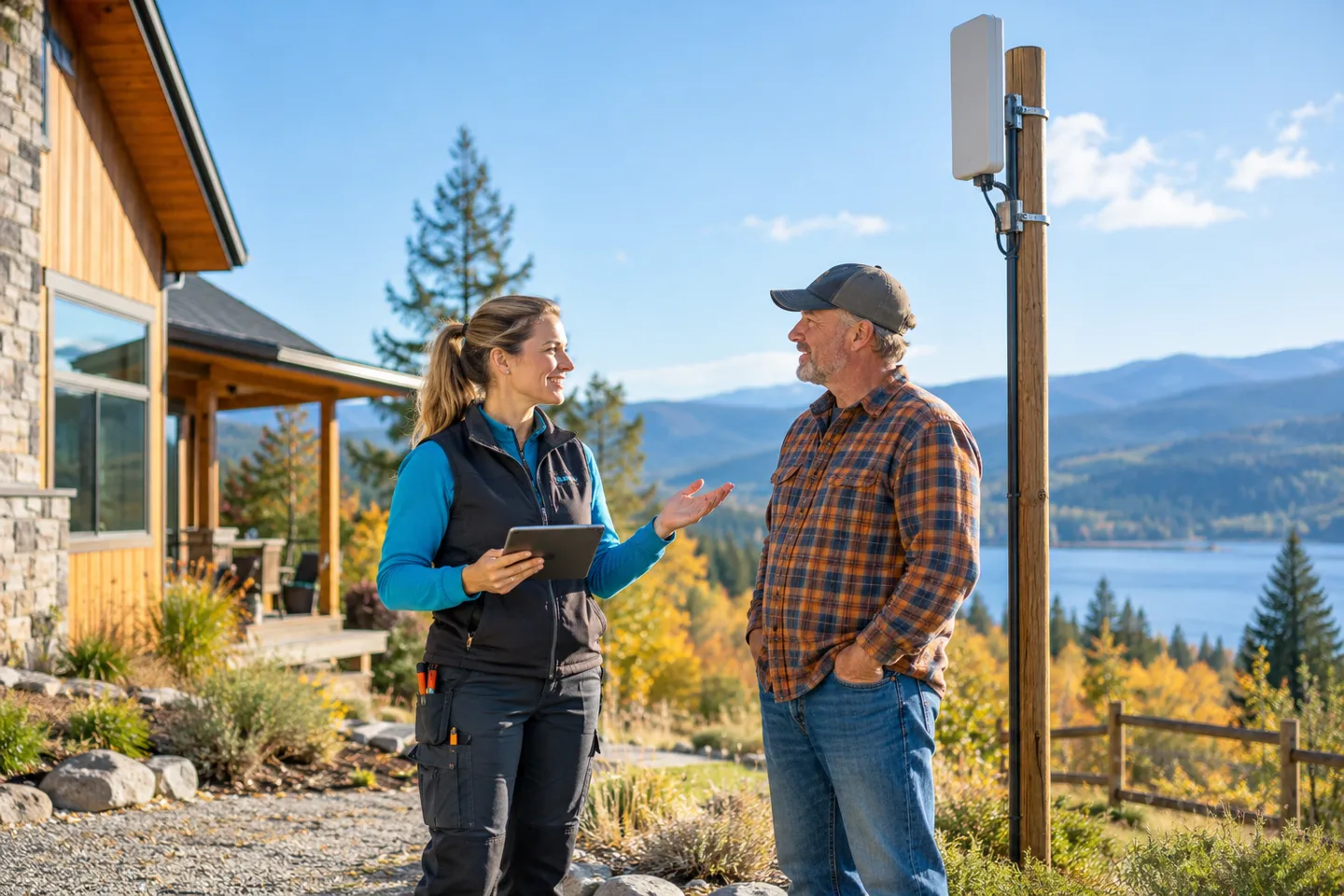
Installer discussing an outdoor antenna with a homeowner